jamming fpv drones
I've previously covered the benefits and drawbacks of fibre-optic FPV strike drones, and of course one of their primary benefits is that they are resilient to jamming, and so in this article we will cover more of the specifics around the effectiveness of jamming. There is often confusion around the use of radio frequency controlled strike drones (often just called "frequency drones" or "RF drones") where, due to the potential for jamming, some people believe that frequency drones are a thing of the past, replaced entirely by fibre-optic drones.
In fact, in mid-2025, Oleksiy Zhulinskiy - the CEO of Ukrainian fibre-optic drone manufacturer 3DTech, reported that only approximately 10% of Ukrainian drones were fibre-optic[1]. Whereas in mid-2025, the Washington Post reported the number as "five to ten percent"[2] and in January 2026 Mezha.ua reported it as "not more than 15 percent[3]".
That said, drone warfare nonetheless accounts for the significant majority of battlefield casualties. With the British Minister for Armed Forces stating in April 2026: "More than 90% of all casualties are linked to drone warfare"[4]. Whereas the French Institute of International Relations stated: "In Ukraine, by 2025, drones are estimated to account for 60 to 70% of all losses across all categories[5]."
In 2026, whilst fibre-optic drones account for less than 15% of drones being used, drones are nonetheless a significant battlefield capability - and many of them are controlled via RF. However, these RF drones are vulnerable to jamming.
But if jamming is possible and it works, why are RF drones still hitting their targets?
jamming is frequency specific
The most basic type of jammers work by transmitting a higher power signal on the frequency the target system is trying to use, in order to overwhelm the receiver and thereby prevent it from decoding the intended signal[6]. This signal must be so powerful that the jammer-to-signal ratio prevents the legitimate signal from being interpreted. Whilst there are some advanced methods of evading this type of jamming, a very simple approach is simply to change frequency to one not impacted by the jammer[7].
In fact, this is a topic often covered by mil-bloggers - who often post when new frequencies are found to be in use, such as through the analysis of downed drones[7][8][9][10]. This mechanism is useful for both jammers and drone detectors, if you are able to determine which frequencies the opposition can detect/jam then you can avoid their capability by using other frequencies[7].
Control Link vs Video Jamming
Drones have two distinct radio systems, the control link is transmitted from the operator-side to the drone, whereas the video link is transmitted from the drone to the operator. In 2026, an increasing amount of jamming effort and capability is focused on jamming the video feed rather than the control link[7].
On hobby drones, and some commercial drones, the control link is provided by a protocol called ExpressLRS (ELRS - Express), which is an open source control link protocol[11]. It typically uses the frequencies 868MHz/900MHz and 2.4GHz - and it is possible to configure an ELRS link to use both frequencies ranges together in a mode called "Gemini Xrossband", which can mitigate interference[12].
In the first half of 2024, Ukrainian engineers forked ELRS and made their own military-focused version, known as MilELRS[7]. Whilst this software remains compatible with civilian hardware, it has several features necessary for the military, such as built-in encryption, multiple drone ("swarm") control, and EW direction finding (to find the location of jammers)[14][15]. Although it has been reportedly possible to retrieve encryption keys from downed drones, requiring keys to be changed frequently[13] and giving the opposition technical information about the capability.
That said, the development of systems such as MilELRS and its alternatives have made jamming the control link much harder and therefore many have shifted focus to concentrate on jamming the video link instead[7]. Note: there is also a military-focused version of Betaflight, known as MilBETA[16].
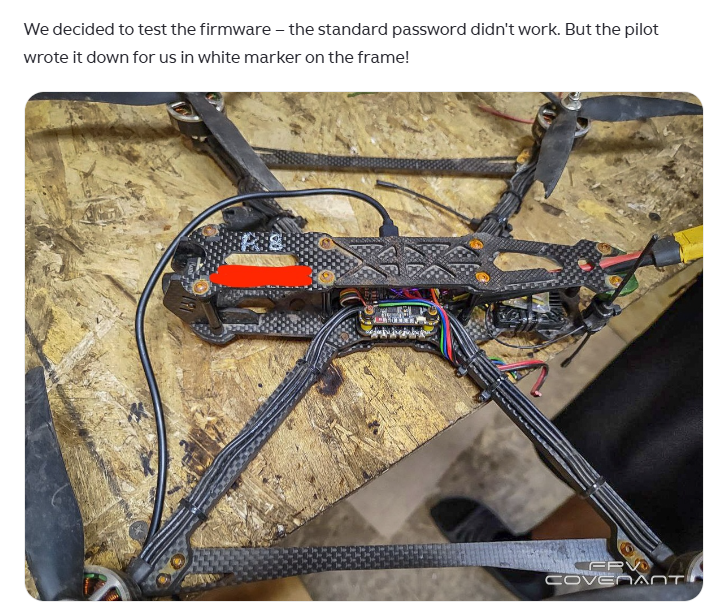
A Russian Blogger claims to have accessed and analysed MilELRS due to access keys being written on a downed drone.
Whilst digital systems are in use in Ukraine, analogue video feeds remain very popular, in part due to their low latency and graceful degradation[7] - the latter of which allows operators to adjust their flight to account for EW interference. Also, analogue is much cheaper than many digital systems.
Disrupting video feeds is frustrated by the requirement to point the jammer not at the drone (as you would for a control link) but at the receiver's antenna[7]. It can be challenging to know the direction of the operator and therefore this makes the use of directional antennas more difficult, which would have otherwise boosted the effectiveness of the jammer by focusing the signal.
jamming is localised
As stated above, jamming works by overwhelming the receiver with a signal much stronger than intended signal. When jamming video feeds, the use of directional antennas may be more difficult, meaning that some systems may be required to use more power rather than more effective directional antennas - this can result in a shorter effective range.
Due to the inverse square law which impacts RF signals, a lot of power may be required to effectively jam a drone. The key detail is the amount of power the drone is sending to its operator and the ratio of distances between the jammer and the drone, and between the jammer and the drone's receiver. A jammer that is twice as far from the operator's receiver as the drone is, will require 4x more power as a minimum to equal its signal strength. One that is three times the distance will require 9x the power. In short: to match a closer signal, a farther transmitter must increase its power by the square of the distance ratio[17].
Another way of looking at this, is by reviewing the range advertised by manufacturers of drone jammers. For example, Shield X SkyBlock, a FPV band jammer, advertises an effective range of 250 meters for that system[18]. Whereas Kvertus advertise 150m range for their Kvertus AD jammer[19]. BlueBird Tech advertise up to 400 meters for one of their trench protection systems[20]. These are not very long range systems - meaning that there may be gaps in the deployment which can allow drones through. Of course, there are more powerful systems available than these trench protection systems, however these are larger, more complex, and require more power to sustain their operation.
Jammers are not always available
As previously mentioned, the power requirements for jammers can be quite high. This is problematic when faced with power blackouts, distributed deployments, and the requirement to sometimes operate from batteries. Additionally, some jammers cannot run 24/7 without breaks. For example, the Kvertus system states that it must be powered down for 1 hour every 24 hours[19]. Finally, EW systems may be targeted by a small number of protected systems such as fibre-optic drones, with the intention of denying the jamming capability to allow further RF drones through. Just because jammers exist and they work, does not mean they are available at a specific location and that there is the power availability to keep the system turned on - and even if there is, these systems can be targeted for destruction.
Of course, eventually these systems will need downtime for maintenance and they may break in use. Some of them even are available with a separate spectrum analyser so they they can be checked to ensure they are powered up and working correctly[18].
Pilot Skill
Another method for mitigating the impact of jammers can be to adjust flight paths to avoid them, this could include reconnaissance to locate where jammers are operating - and any potential gaps, but it can also include techniques such as terrain masking to avoid the impact of jammers.
fratricide
Another limitation on the potential for "always-on" jamming, is fratricide. That is, where jamming designed to prevent enemy drones may disable or prevent the use of friendly drones. This creates a trade-off between continuous jamming and effective friendly drone use. As a result, jamming may be performed more selectively, or jammers disabled until an enemy drone is detected.
Terminal Phase AI Targeting
Finally, just because a jammer is available, is working correctly, is powered on, and has all the power availability required to keep them online, does not mean that they can stop all strike drones. Yes fibre-optic drones can bypass them, but even RF based drones have options. For example, some drones are fitted with terminal-phase computer vision. This means that the operator (or even the drone itself) can lock on to a target during flight and if the drone is jammed after the lock-on has been achieved, the drone itself can fly using AI and computer vision to strike the target, even after the video and control link are broken[21].
Jammers exist and they work, but they do not offer complete protection against strike drones.
Note: much of this article focuses on the most simple form of jamming, which is simply overpowering the intended signal, but there are many other types. For example, an analogue video feed can be effectively jammed by injecting illegitimate sync pulses into the video feed to cause tearing and rolling in order to disrupt the operator's view. Additionally, whilst we focused on jamming of the control and video links, these are not the only systems targeted by jammers - for example, GNSS may also be jammed.