Basics: Frames
Note: Bigger quads (generally 2.5" and above) are referred to by the size of their propellers. So when we say a "five inch quad", we mean the quad has propellers that measure five inches across. However, with micro whoops and other very small quads, the measurement given is the "wheelbase". This is the measurement from the centre of one motor to the centre of the motor diagonally opposing it. The most common whoop sizes are 65mm, 75mm, and 85mm.
There are four main drivers for selecting your quad frame: prop size, weight limitations, ruggedness, and component fit. Prop size is generally the most straightforward choice, whilst you might fit 5.1" props on a frame designed for 5", you'll certainly not fit 10" props on a 5" frame.
I'll cover prop size choice in more depth in its own article, but in short: If you need to stay below 250 grams for regulatory purposes, then you're likely limited to 3.5" frames and below. If you want a good all-round frame for a freestyle build, then 3.5" and 5" builds are sensible default. But, if you want to carry an action camera, you'll be better off at 5". If you want to fly very long range, then bigger props will help with that, so a 7" build is a sensible starting point. I would warn you not to go above 7" until you really know what you're doing. For a first build, 3.5" and 5" are good starting points, but if you want to make it a little easier to stay sub-250 grams, then a 2.5" or a 3" will definitely make things easier. I strongly urge you to start small and work your way up. That said, there are pilots out there that fly nothing but 75mm micro whoops, if small works for you - then stay small!
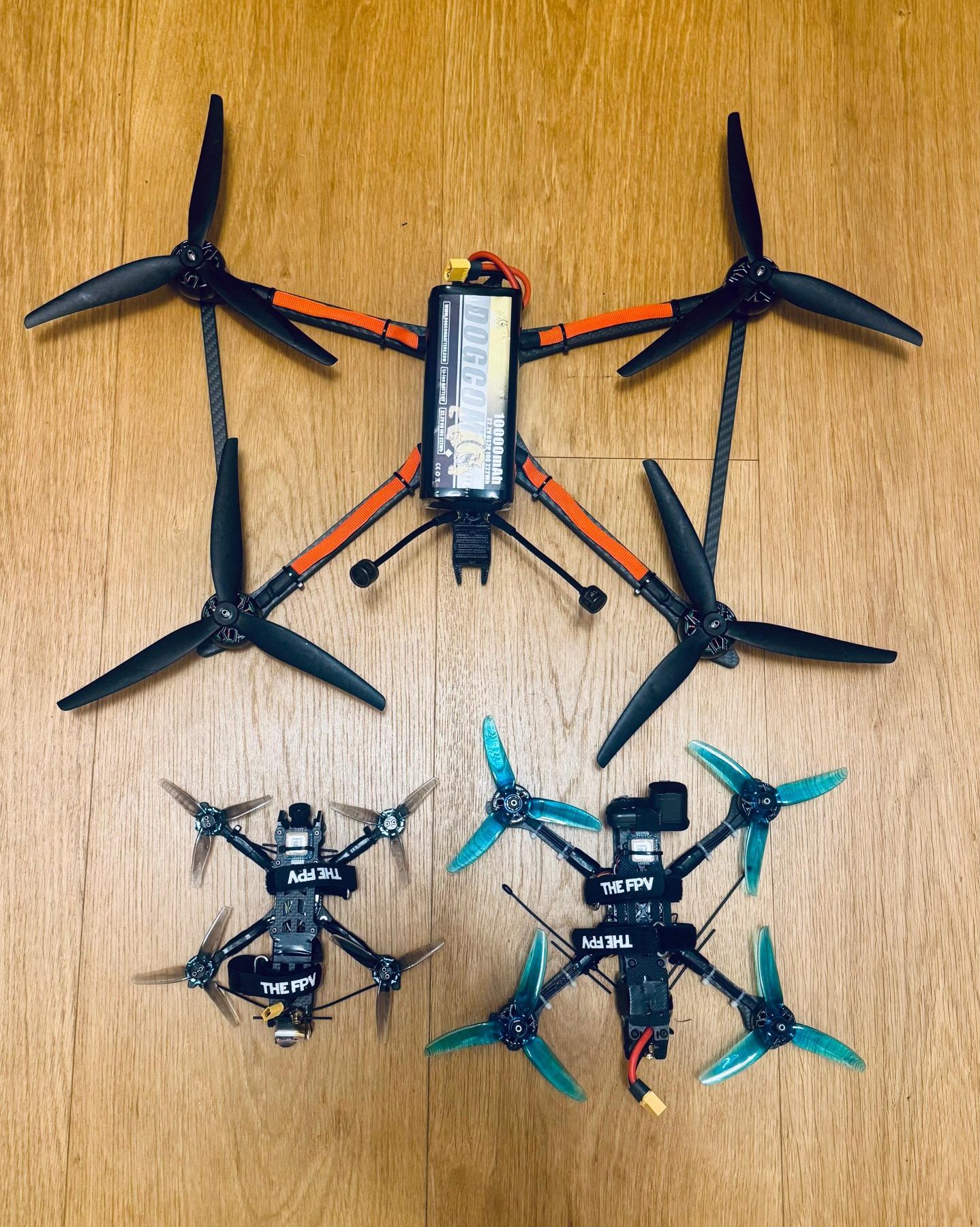
Quad size comparison: a 10" quad is shown above a 3.5" and a 5".
Frame Shape
So regulation and the type of flying you want to do are likely what will drive your prop size. Your prop size will give you a starting point for your frame options, but the next thing to help narrow it down will be your frame shape. There are a surprising number of frame shapes, but most commonly you'll see box, true-x, and deadcat frames. Of course there are many more options than these, for example Y frames for tricopters exist. But, I would recommend your first decision is whether or not you are happy for your props to be visible in your FPV video.
Personally, I love seeing props in DVR footage, but then I do fly analogue so a lot of that is for the "vibe". If you're building a cinedrone and you want to use the FPV camera itself for the footage, rather than carry an action camera, then you'll likely want to choose a frame that keeps the props out of view. That's going to push you towards frame shapes such as the Deadcat. Where the front arms are swept-back slightly (in comparison to a True-X) to ensure the props aren't visible in the footage, at the cost of just a little bit of maneuverability and stability.
If you want your props in view, or don't care whether you can see them, then the starting point would be a True-X. Although there is also the option of a "Box" where the motor mount points are joined together to add a little more strength at the cost of some additional drag.
Of course, it's not just as simple as "Box, X, or Deadcat?". In the photo above the top quad is a 10" Deadcat, that's pretty clear. But the bottom left is a 3.5" Volador Vx35, which some people call a "Squashed-X" and the bottom right is a Source One v5 frame, which some people call a "wide-stance X". These variations then lead some people to call a perfectly symmetrical X frame a "True-X".
Component Fit
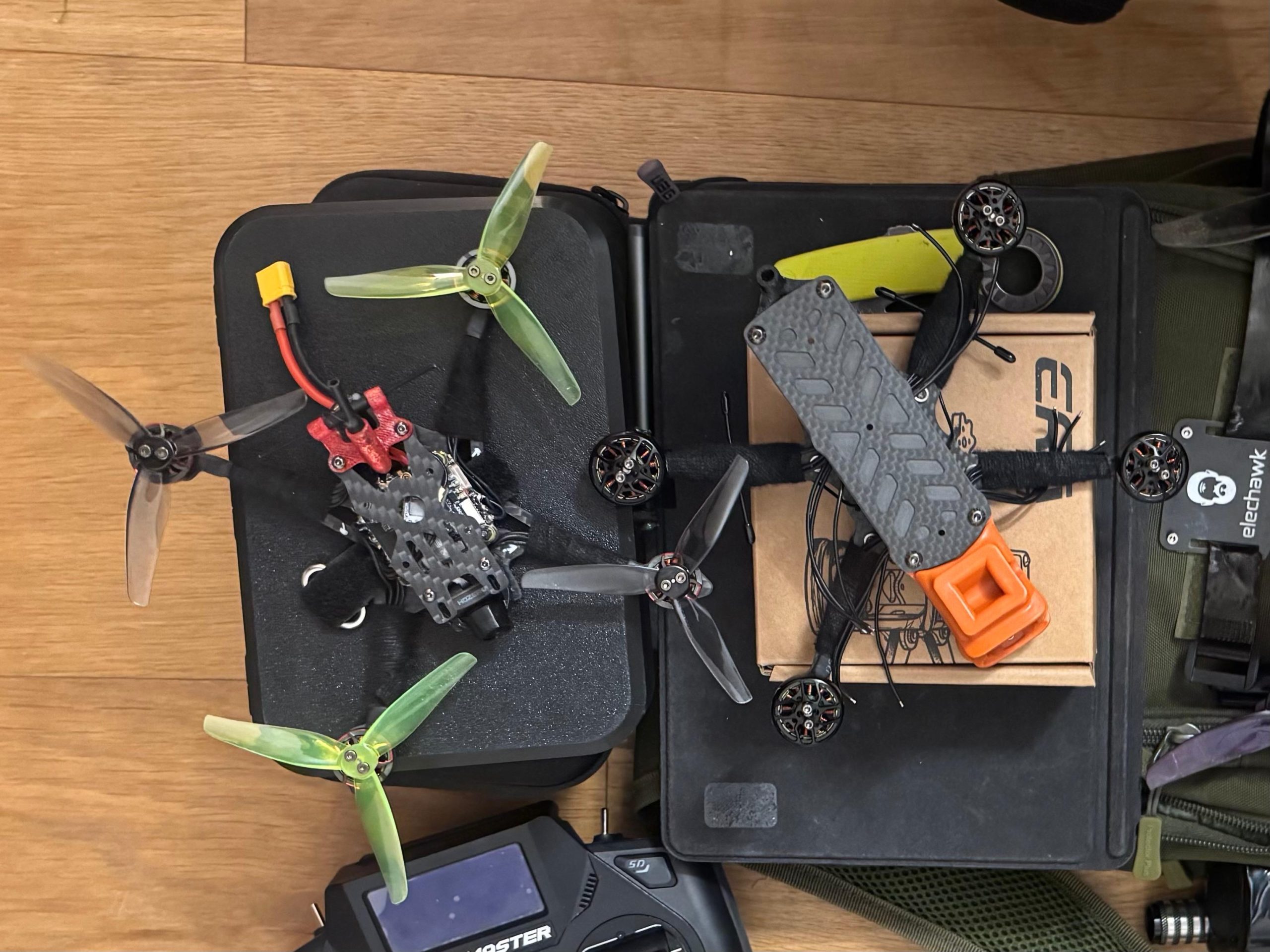
Another thing to consider with your frame choice is, where are all of your components going? The photo below is a really good example of this. The frame on the left is a Crux35 and the one on the right is a Era 3.5, they're both 3.5" frames, but the space inside the body of the quad is very different. For the Era 3.5, I've used a 20x20 stack and a HDZero Freestyle v2, but that's far too big a setup for the Crux35. For that build, space is severely limited, so I've used an F405 AIO and a HDZero Whoop v2 VTX. Both great setups, but those component choices were definitely limited by the frame.
Crashing
The final thing to consider is the "repairability" and resilience of the frame. Again the Crux35 and Era 3.5 are a good comparison here. The Crux35 build is comfortable sub-250 grams whereas the Era is 320 grams. However, the Era has much thicker arms and a much sturdier camera mount. Plus, if you break an arm on the lightweight quad then you need to replace the whole bottom plate, which is quite a lot of work. The Era on the other hand allows for arms to be removed easily with just a single screw.