Types of Batteries
Of course there are loads of different kinds of batteries out there and companies are constantly trying to develop new technologies, such as sodium-ion batteries and graphene batteries - but you'll mainly come across three types of batteries in the FPV space: Lithium Polymer (LiPo), Lithium High Voltage (LiHV), and Lithium-Ion (Li-ion).
Of course each have their pros and cons and so you'll find them most often used in specific niches in the hobby. You can consider LiPo as the default. You'll most commonly find LiHV are most often found on quads where weight is a major concern, such as micro quads and whoops. You'll most commonly find Li-ion where high amp output is less of a priority, such as very long range quads.
Battery Characteristics
C Rating
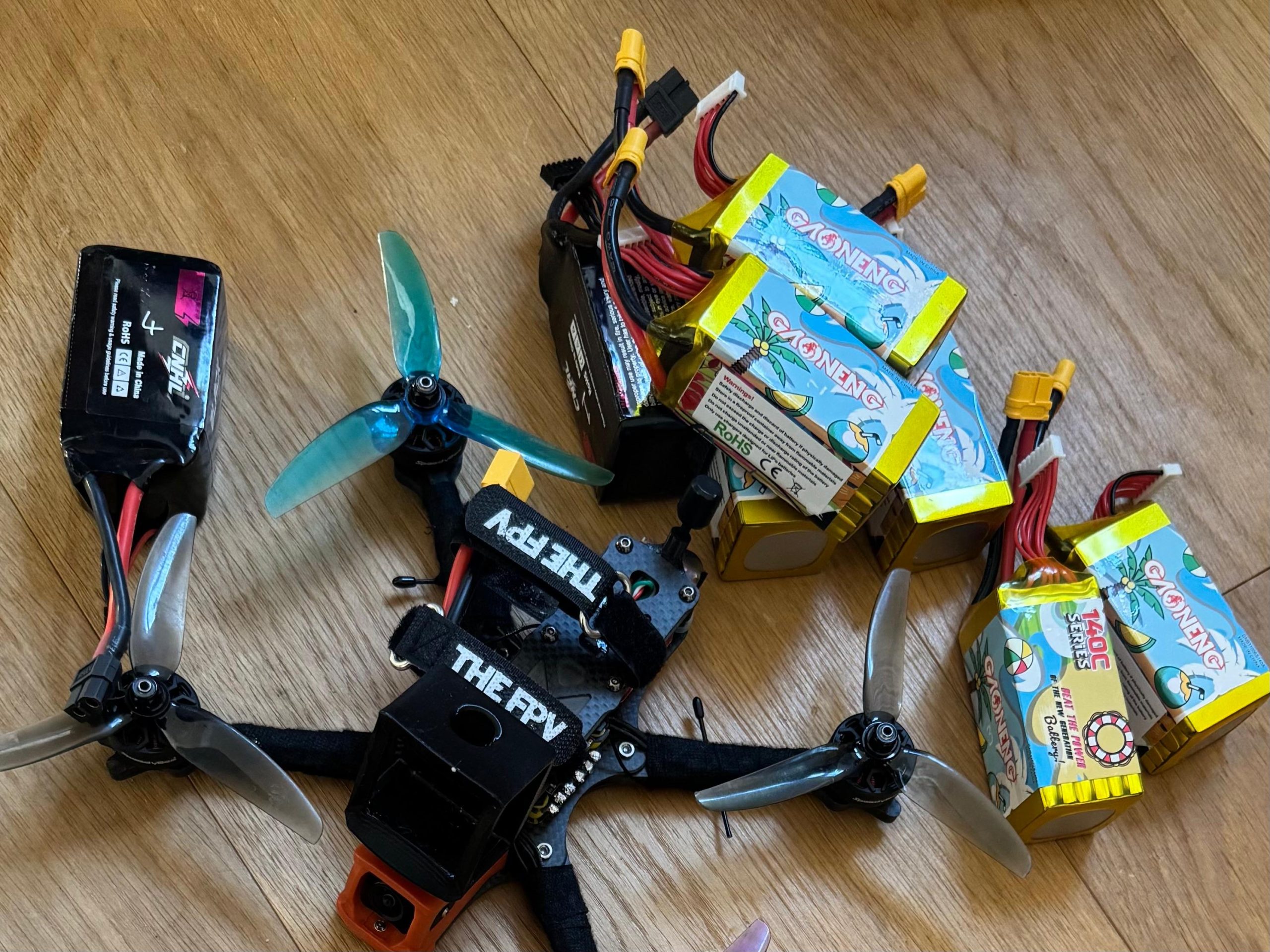
LiPo batteries offer a good balance of capacity to weight and offer potentially huge power output. You'll see the potential output capability of a battery given as it's "C" rating. Generally the C number on a battery refers to how quickly it can discharge as a multiple of its capacity rating. So my 5000mAh Li-ion battery with a 10C rating can potentially output 50 amps. That sounds like a lot but you'll find ESCs that advertise 60 amp output per motor. I have a 1100mah LiPo battery which advertises 140C, so it could potentially output 154 amps.
You'll see lots of "potentially" and "advertises" in this section as the numbers written on the battery aren't always entirely accurate, of course some unscrupulous companies may exaggerate the capabilities of their batteries. That said, in general LiPo batteries can output very high amperage and that's why freestyle pilots love them.
On the other hand, whilst Li-ion batteries often have a much lower C rating, they have a higher energy density, meaning when comparing a LiPo and a Li-ion of similar weight, the Li-ion will hold more power - which is why they're loved by long range pilots who are likely pulling much lower amperage but really wanting to optimise their capacity to weight to squeeze the most flight time out of their setup.
Be aware that the C rating written on a battery is typically its discharge rating. A battery will almost always have a much more conservative charge rating. Typically between 1 and 5C. So whilst my 1100mAh battery will output 140C the manufacturer states not to charge it above 5C. Some very conservative pilots will always charge their batteries a 1C to maximise their lifespan. Personally, I typically charge at 2C to balance the batteries lifespan with its charge time.
Voltage
A battery's output voltage is determined by two factors, its cell voltage and its cell count. You'll hear these referred to as an S value. With 1S, 2S, 4S, and 6S batteries being the most common. These are the number of cells in series - and in fact you could write something like 6S1P to mean "6 cells in series, and 1 in parallel", so 6S and 6S1P are the same thing. Although in different niches you will come across other less common values such as 3S for some sub250 quads and 10S or 12S on UGVs and heavy-lift quads. The largest battery that I own is a 22000mAh 10S battery - and it weighs 3.5Kg.
A general rule of thumb in the freestyle space is, the bigger the quad the higher the voltage. So my whoops run on 1S batteries, my 3.5" quad runs on 4S and my 5" quad runs on 6S. Although it's all a balance of output power and weight and so you will find different configurations where people are optimising for different things.
If you have a quad that came from the factory with one battery, you may be able to run a higher voltage battery and get more speed out of it, however as always there are several factors in balance. Your stack must be able to support the higher voltage and your motors must have an appropriate KV rating. You'll often see stacks and ESCs advertised with their voltage capability (such as "1S to 4S", or "2S to 6S").
Higher voltage isn't always better, although it will generally lead to a faster top speed it will also likely lead to a shorter flight time.
Different battery technologies will have different voltage ranges and a different nominal voltage. LiPos typically operate between 3.0V and 4.2V. Discharging a cell below 3.0 volts can damage the cells. So a 4S LiPo will typically operate between 12V and 16.8 volts. When discharging the voltage drop will not be linear and instead follows a curve where it will drop rapidly at first, level off, and then drop rapidly at the end. During aggressive flying and freestyle tricks you will see voltage lag where the battery voltage drops rapidly and then recovers when you return to smooth flying.
LiHV cells can be charged slightly higher than LiPo, up to 4.35V. This is one of the reasons they are preferred by whoop pilots that still require high discharge capability but want to squeeze everything they can from their batteries to get longer flight times. Although to some people feel they have a shorter lifespan than regular LiPos. Li-ion on the other hand can be discharged to a lower voltage, often down to 2.5V.
A very common question is "when should I land?". I recommend that with LiPo/LiHV batteries, you never let any individual cell drop below 3.0 volts. That does not mean that you should return to land at 3.0 volts, it means that at no point in your flight should a cell drop below 3.0v. To ensure this, you may prefer to come in to land at 3.3 volts to ensure you can return and land with some margin. If you're a conservative flier that wants your kit to last a long time you might prefer to return at 3.5 volts to ensure that you have some remaining capacity to handle any unexpected events (such as dogs running onto your landing spot). That said, you'll see a lot of pilots online really pushing their batteries. Well some of them don't care about their kit and some of them are sponsored so aren't buying their own batteries. Ultimately the "land now" voltage decision is yours.
You'll likely find with freestyle flying that when performing tricks you battery will sag down to your chosen return to home voltage and once you start your return flight, which will likely be much more gentle, the battery voltage may appear to increase! Of course, in actuality your battery has just "relaxed" out of the voltage sag. Keep an eye on that voltage as you fly and you'll develop a good feel for when you should actually return so that you're not landing with too much capacity wasted and you're not getting too close to that do not exceed minimum.
Connectors
These days the significant majority of quads use XT connectors. With the most common being XT30 and XT60. Although some macro quads out there might be running the bigger XT90 and whoops have a few different connectors that they might use, such as BT2.0, PH2.0, or an XT30.
With XT connectors the higher the potential amp draw the bigger the connector. So whilst you can get connectors that will reduce an XT60 down to an XT30 - it's not necessarily safe to do that, depending on how many amps you intend to put through that connection. An XT30 will typically support half of the amps that an XT60 would.
As for whoops, the BT2.0 is the superior connector to the PH2.0 and if you have the option I would always go with the BT2.0 and in fact would personally swap out a PH2.0 on any whoops I own, which is a relatively simple soldering task. In short, the connectors in the BT2.0 are better and therefore cause lower voltage sags and are rated for higher amp delivery. Additionally, I personally thing there's a slight quality of life improvement with the BT2.0 not having a wire which makes them easier to store and charge with devices such as the Whoopstor.
Balancing
All FPV quad batteries that have more than one cell should have a balance connector. Balancing your batteries prevents over-charging or over-discharging of individual cells, which is both a safety matter and better for the lifespan of your batteries. Therefore I recommend you only use a balance charger and that you balance every single time you charge.
Also note that the balance connector on your battery is fragile and prop strikes can really mess them up. You should not be breaking balance connectors, even in the most aggressive of flights. So protect them! Whether you 3D print something to hold them in place, tuck them under your battery strap, or use an elastic band to hold them in a safe spot. Protect those connectors. You can replace those connectors but it can be dangerous as it can easily lead to a battery short, so it's much better to avoid damaging them in the first place.
Chargers
The only recommendation that I have for chargers is only ever use balance chargers. That said, there's some nice quality of life things to look out for. For example, I prefer chargers that allow me to charge from both AC and DC. When you first get started the DC to DC charging feature seems pointless - but I actually use it all the time, especially for my whoops. Another quality of life thing to look for is USB-C reverse charging, not essential but a really nice feature to have.
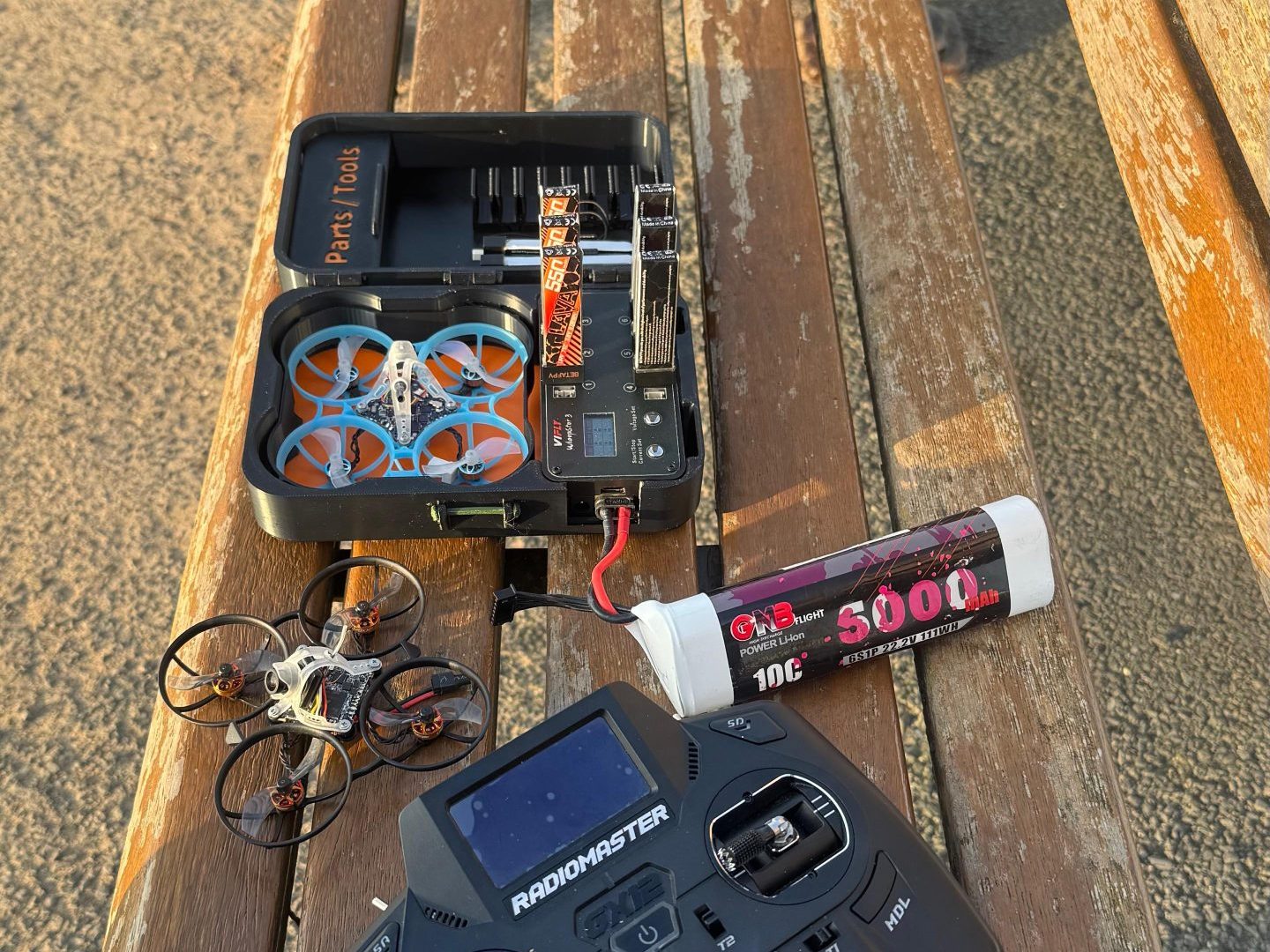
For example, for my Air75-style whoops I use 1S batteries that I charge using a Whoopstor. The whoopstor itself accepts power from USB-C or from an XT60. That means I can also carry a 5000mAh Li-ion battery, which fits nicely in my kit and charge my whoop batteries from that in the field. You can see me doing that in the photo above - charing six 1S batteries at once.
For my bigger quads I like to use the B6neo+ which is a tiny charger that accepts USB-C or XT60 and outputs to XT60. This is great for charging a single battery in the field since it's so small - but it also have USB-C reverse charging, so if my phone or action camera get low I can also charge those from my Li-ion.
The only problem with the B6neo+ is that it only charges a single battery at a time and so you'll either want to get a couple of them so you can more easily charge everything before you head to the field. Alternatively, something like the D100neo can charge two batteries at once. I have one of these sitting on my desk, plugged into the AC, so I can charge before I head out.
Storage
You should not store batteries charged or fully discharged long term. Ideally your LiPo should spend most of their life at 3.80-3.85 volts. So if you're not going to fly for a while, you should charge them to this "storage voltage". You'll find most chargers have an option to charge/discharge to this voltage as necessary. This will ensure you get the maximum lifespan out of your batteries.
Now some freestyle pilots take the approach that they're going to crash and abuse their batteries so much anyway that storing at storage voltage is a waste of time. They may keep them fully charged at all times so that with any opportunity to fly they can immediately get airborne. Ultimately that decision is up to you.
Some pilots also report that when they land and allow their battery to relax it ends up "close enough" to 3.8, so they don't bother with storage mode on their charger. They simply charge all their batteries, fly all their batteries, and then put them away until next time. If that works for you, great.
For me, whilst I'll head out with 12 packs, I might only end up flying 10 of them. There's lots of reasons this can happen, like sometimes the weather turns, or I break something, or I end up flying something different like whooping the spot or flying the 3.5 instead. When I get home, I'll discharge those extra packs to storage.
Numbering
At some point you'll come across someone with numbers written on their packs. Paint markers are great for this. But why do they do it? Well if you have 10 packs but often only fly 8 of them - and its always the same two that get charged but not used - then the level of use across your packs is uneven. Some people dislike this.
I see this most often in the commercial space where companies may be required to keep maintenance logs and track charge cycles. They don't want to end up with some packs in the box with 250 cycles on them and some with only 10 cycles. So numbering them allows them to track them and ensure each pack gets a similar amount of use.
Whether you number your batteries, tally on them every time you charge them, or write on the date of first use. Tracking your packs gives you more information about the state that they're likely in and will help you know when it's time to replace them. That said, you'll probably crash and frag the battery long before it hits 250 cycles anyway, so is tracking its use worth it? That's up to you.
Damage
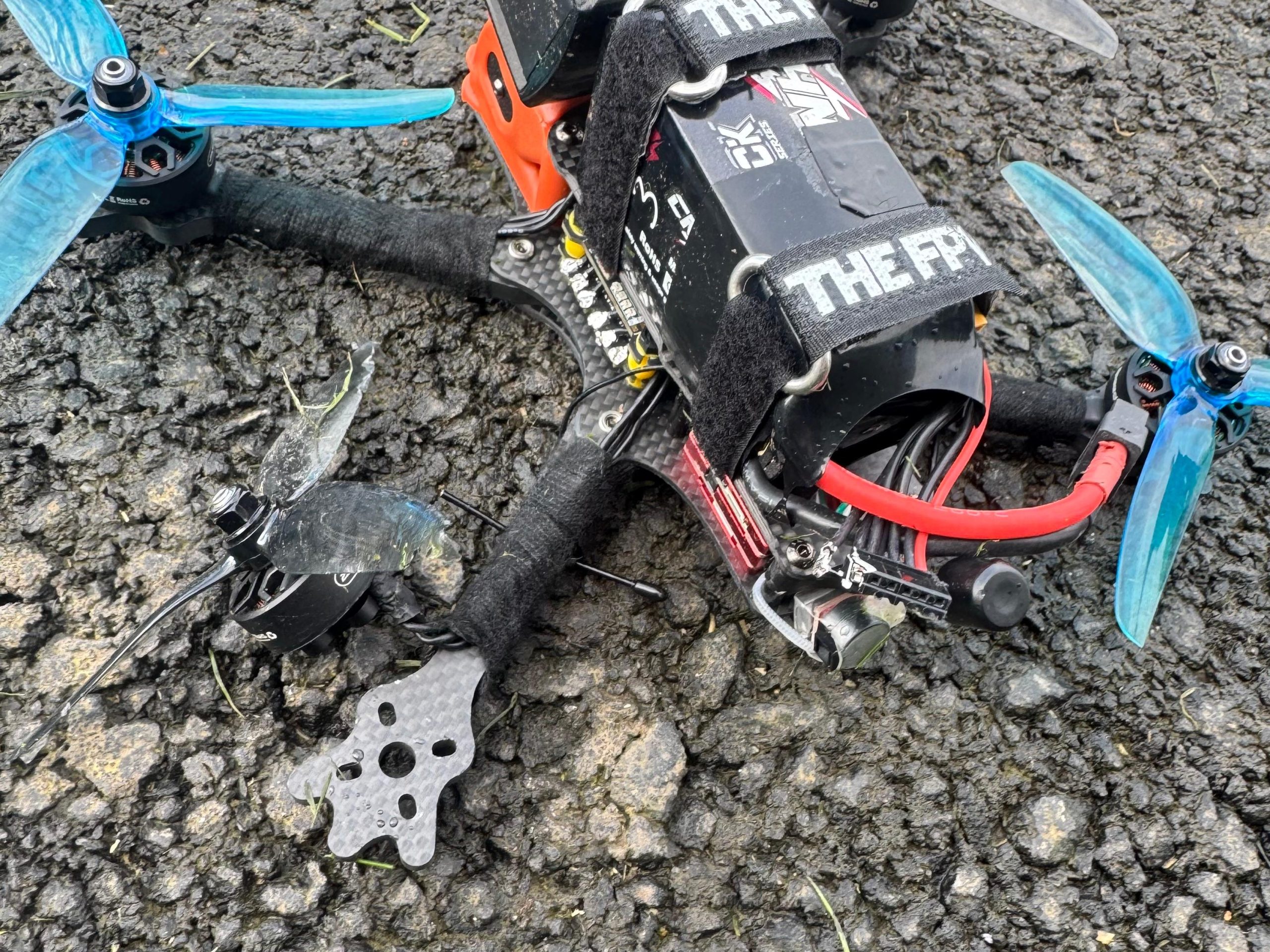
As you crash your quad you're going to sustain battery damage. This could be damaging the cells themselves making them misshapen, it could be damaging the case exposing the cells, damaging the balance connector, or damaging the XT60 or its wire. Personally I do not want to deal with a LiPo fire, so pretty much any damage other than cosmetic and I'm going to dispose of that battery and get another one.
Some issues can be fixed, for example replacing a balance connector is possible - although it's a very annoying and potentially spicy repair as its very easy to short the cells if any of the balance wires touch. You can also rewrap batteries quite easily with some heat shrink if you have just cosmetic damage. That said, if your battery starts swelling, I'd dispose of it.
Many chargers will also give you information about the state of your battery, as can common sense. You batteries should not be getting hot when charging at 1C or 2C. So check them. Your charger will also likely tell you the cells internal resistance and their individual voltages. If any individual cells are significantly different to the pack as a whole, then that can indicate a problem internally with the pack.
I've been very careful here to say "dispose of" and not "throw in the trash" or similar. When a LiPo has reached end of its useable life you should safely discharge it with a LiPo killer or similar device and then dispose of it according to "your local state laws". In practise, a quick internet search should tell you somewhere locally you can get rid of them. These days there's lots of options, such as auto-parts stores, supermarkets, and local government drop off centres. Do not throw them in the trash.