Video Antennas
Most new pilots will at some point look to upgrade the antennas that come with their goggles and video transmitter and quickly fall foul of the many different options. You'll come across terms like LHCP, RHCP, patch, omni, and crosshair - and may not know what those mean. So we'll cover off the basics here.
Polarisation
What polarisation is, is largely unimportant to pilots of FPV quads. Most people will simply learn that the polarisation at each end (as in on the goggles and on the quad) must match and they're unlikely to think much more about it. Other pilots might find out that Analogue and HDZero conventionally use RHCP and WalkSnail and DJI conventionally use LHCP, and they may read no further. You'll generally be fine if that's your approach.
Polarisation refers to the geometrical orientation of a radiofrequency wave. Polarisation can be linear, where it oscillates in a single plane, or circular where it rotates as it propagates. Linear polarisation is less effective in FPV quads because the orientation of the antennas then matters - and since the orientation of your quad will vary significantly throughout your flight, you will get less performance out of your video link. Additionally, circular polarisation handles multipath interference better.
Therefore, circular polarisation is the standard and is used almost everywhere. However, you may get some cheap linear antennas with your goggles for free - you should probably just throw these out. You may also find that a lot of micro drones like whoops use linear antennas. You may wish to upgrade these on your whoops but as these tend not to be flown very far you might find that it doesn't cause enough of a problem for you to require the upgrade.
As for RHCP or LHCP, this is simple: Right-handed Circular Polarisation and of course, left-handed. You can use either that you prefer, as long as the polarisation handedness is the same on both sides. Whilst there is a convention for which should be used on each system, they're your quads and you can do what you like.
For example, if you regularly fly WalkSnail and Analogue, whilst analogue conventionally uses RHCP you may prefer to use LHCP to save you needlessly buying a second set of antennas for your goggles.
Personally I fly HDZero and Analogue using the HDZero Goggles 2 - and the fact that I can just put RHCP on everything and it'll just work (The Goggles 2 have a built-in analogue receiver) is really convenient.
How can you tell an RHCP from an LHCP antenna externally? Generally you cannot, so antennas usually have "RHCP" or "LHCP" written on them. Alternatively, they sometimes have a clockwise circle of arrows to indicate RHCP (and counter-clockwise for LHCP).
Directionality
The directionality of antennas matters a great deal. There is only so much power to be transmitted and if you send it out in all directions then some of that power is wasted, but if you only send it on in a narrow beam and that beam is not pointed in the correct direction, you will lose link.
Omni-directional antennas, usually just called "omnis", send and receive in almost every direction. Almost being because their radiation pattern is actually toroidal (donut shaped). So whilst you won't get a good signal directly above and below, in most directions you will. So omnis are great.
However, omnis have limited range in comparison to an antenna that has a directional radiation pattern. Putting a directional antenna on the quad is unconventional outside of very niche use cases, however you could easily put a directional antenna on your goggles and just make sure your head is always pointed in the direction that you're flying!
The narrower that pattern, the further you will be able to fly, but the more accurate you need to be with ensuring your antenna is aligned with the quad. For example, crosshair antennas may have a beam width of around 110-120°, whereas a helical antenna may be as tight as 40° (they can be between around 40 to 100° depending on the number of "turns" in the antenna).
The extremely narrow beam antennas are often combined with an auto-tracking ground station. So instead of wearing them on your goggles and needing to ensure you head is always pointed in the right direction manually, a ground station will automatically track the signal strength and rotate the antenna to track the quad in flight.
You'll very often see people with both a patch and an omni antenna on their goggles, to get the "best of both worlds".
Diversity, Fusion, and Mixing
When your receiver has multiple antennas, how swaps between those antennas can introduce problems. The most basic form is antenna diversity, where the system constantly checks which antenna is receiving the strongest signal and swaps to that one. This can cause issues if the receiver constantly "flaps" between antennas, which can introduce issues such as white flashes in the view.
An alternative approach, rather than swapping between antennas, is to combine the signal received from both - this may be called "Fusion" or "Mix Mode". There are often different mix modes (e.g. Mix1, Mix2, Mix3). The specifics of each mode will differ between different manufacturers, but in general the lower the number, the lower the level of intervention the system is performing - such as less aggressive sync reconstruction.
Sync Reconstruction
Analogue video utilises "sync pulses" to tell the receiver when to start a new line or a new frame. However, when the signal is very weak these pulses can be lost. This can lead to the displayed image being distorted, for example rolling vertically. However, some receivers are able to perform sync reconstruction where they inject artificial pulses to prevent this rolling.
Connectors
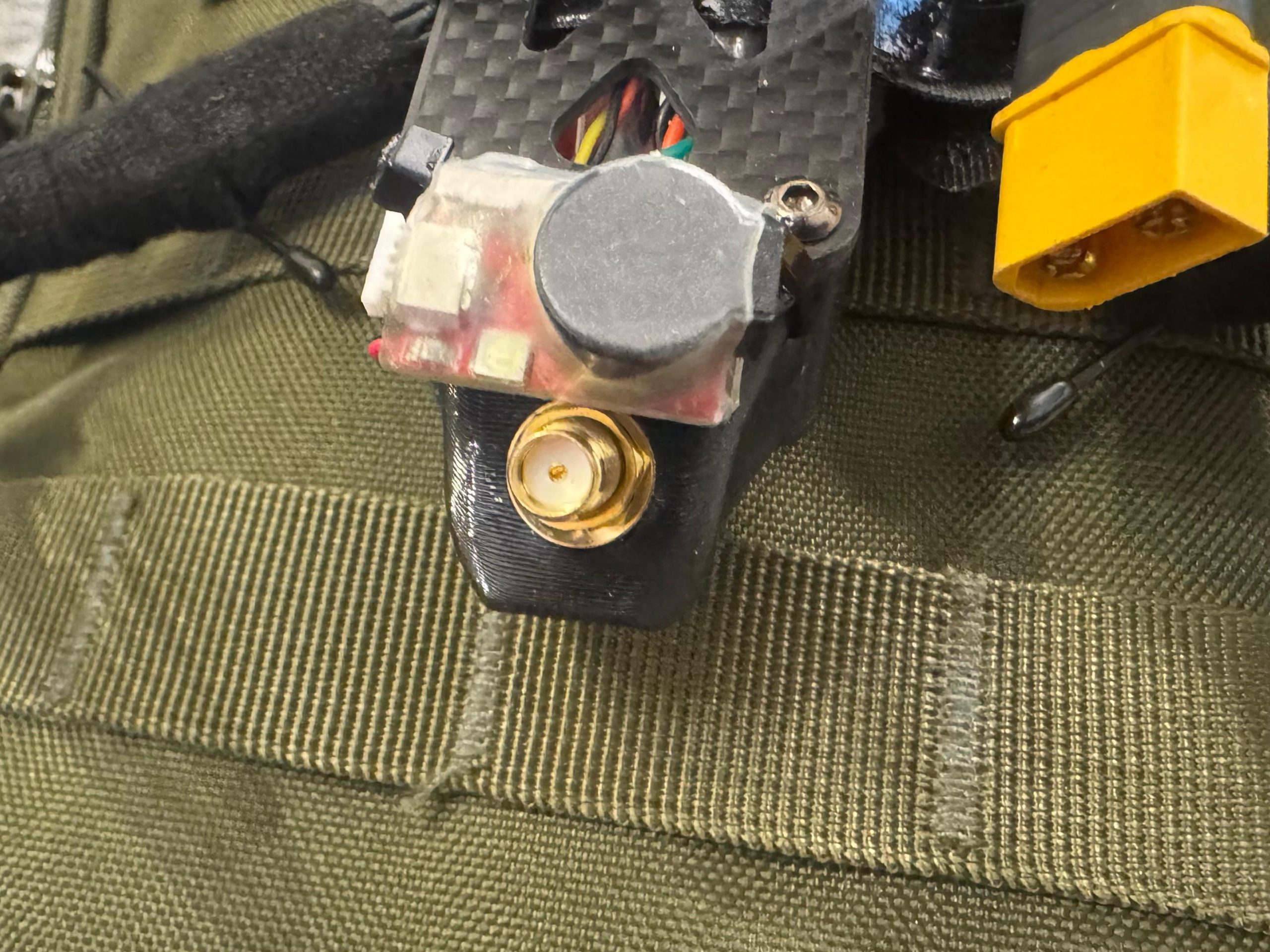
There are several different connectors available for your video antenna. The most common are U.FL, SMA, and RP-SMA. U.FL are very small connectors, generally surface mounted onto circuit boards. These are often found on VTX. You may connect an antenna directly to a U.FL or you may connect a "pigtail", which is a short (e.g. 5cm) piece of wire with different connectors used to convert the connection. For example, I typically use a 5cm pigtail with a U.FL on one side and an SMA on the other (as shown above).
One thing to watch out for though, is the difference between SMA and RP-SMA (Reverse polarity). These are incompatible. Whichever one you choose does not matter, but if you have an RP-SMA pigtail, you must use an RP-SMA antenna.
The connector shown above is a female SMA. This means that at the centre of that female connector is a hole. The RP-SMA equivalent would have a pin in the centre. It can be very difficult to tell what type a connector is in a photo, but it is obvious when it is in front of you. The RP-SMA female connector has a pin approximately 3mm in length.
Also it's worth nothing that some micro drones like whoops do not have an antenna connector, instead an antenna wire is directly soldered to the board.
Finally, never power on a VTX without its antenna connected - this can quickly and permanently damage it.